The main role of front-end engineers working in IT companies is to develop the screen interface that users can see. Engineers, not just front-end engineers, need to be able to use programming languages, and there are also programming languages that are suited to front-end engineers.
What kind of language knowledge and skills should front-end engineers working for IT companies acquire in order to be successful in the future? In this article, we will explain the programming languages and frameworks that front-end engineers should learn in order to be successful in the future, as well as the future prospects for front-end engineers and what they need to do in order to be successful.
If you are looking for a job as a front-end engineer at an IT company, please use IT engineer-focused recruitment agency “G Talent”.
Contents
- 1 What is a front-end engineer working at an IT company?
- 2 Programming languages that front-end engineers at IT companies should focus on from now on
- 3 Basic languages that front-end engineers in IT companies should know
- 4 What is the future for front-end engineers in IT companies?
- 5 What you need to do to work as a front-end engineer in the future
- 6 If you are looking for an IT company where you can work as a front-end engineer, try "G Talent"
- 7 Work at a Japanese IT company as a talented front-end engineer!
What is a front-end engineer working at an IT company?
A front-end engineer working at an IT company is an engineer who develops the parts of websites and web apps that users can see. They use various programming languages to create screen designs and movement exactly as the web designer has designed.
In addition to front-end engineers, back-end engineers are also needed for the development of websites and web apps. The back-end is the part of the program that runs on the server in response to requests sent from the screen to the server. The job of back-end engineers is to develop programs on the server that are not visible to users.
Front-end development is an important part of developing websites and web apps that users use. High-quality front-end engineers are essential for creating easy-to-use, easy-to-view, high-functionality websites and web apps. As the number of websites and web apps is expected to continue to increase, demand for front-end engineers is also expected to remain high.
Reference: フロントエンドエンジニアの将来性と求められるスキル・資格を解説/レバテックキャリア
Programming languages that front-end engineers at IT companies should focus on from now on

From here, we will explain the programming languages that front-end engineers who want to become active in the future should learn, as well as frameworks that make programming languages easier to use. We will introduce programming languages and frameworks that are likely to develop in the future, so if you come across any you don't know, make sure you get to grips with them. If you want to become even more active as a front-end engineer from now on, please make sure you refer to this.
PHP
PHP is not a programming language of the future, but a general programming language that IT engineers should know. PHP is used mainly in the back-end, but it is also a major language used in services such as WordPress, so it is expected that front-end engineers will have more opportunities to use it in the future.
Some companies need engineers who can build and customize WordPress, so learning PHP is recommended to be able to handle a wide range of work. Because its syntax is simple, it is one of the languages that is relatively easy to learn.
Reference: PHPとは?基礎知識、できることを初心者にもわかりやすく解説します/カゴヤのサーバー研究室
TypeScript

This is a programming language that allows type declarations and was developed by Microsoft as an extension of JavaScript, a standard programming language for front-end engineers. By declaring types, you can prevent errors when compiling the source code, so it has the feature of improving development efficiency. Compared to JavaScript, it has the advantage of reducing the occurrence of bugs and allowing you to develop safely and efficiently.
Development using TypeScript is becoming mainstream, and there is also a movement to rewrite JavaScript code in TypeScript. For this reason, it can be said that it is a language that should be mastered as a front-end engineer.
Reference: TypeScriptを入門者向けに解説!JavaScriptとの違いや勉強法までわかりやすく/Udemy media
Next.js

Next.js is a framework developed based on React.jp. React.jp is a library used when developing user interfaces in JavaScript, and it is effective for efficient development in JavaScript. Using Next.js makes it possible to increase the efficiency of web app development.
The biggest difference between Next.js and React.jp is the presence or absence of server functions. Next.js has server functions, so you can run web apps on their own, and it has the advantage of easier environment preparation and lower learning costs than React.jp. Using Next.js allows you to develop efficiently in JavaScript, so it is recommended for those who want to become active as front-end engineers in the future.
Reference: Next.jsとは?Reactとの違いやインストール・基本操作を解説!/Udemy media
Nuxt.js

Nuxt.js is a JavaScript framework based on Vue.js. Vue.js is also a JavaScript framework like React.js, and it has many advantages, such as components that can be used like program components and extensibility that allows the use of plugins. Nuxt.js is a more user-friendly version of Vue.js, and it is possible to greatly improve development efficiency.
While Vue.js does not have a server function, Nuxt.js does, so Nuxt.js is easy to use without the hassle of installing server libraries, etc. For this reason, we recommend that front-end engineers who want to become active in the future learn Nuxt.js.
Reference: Nuxt.jsとは?Vue.jsとの違いやできること、メリットを解説/TECH MANIA
Svelte.js

Svelte.js is a JavaScript framework that is not as major as React.js or Vue.js, but it is expected to develop in the future.
While React.js and Vue.js are classed as libraries, Svelte.js is a compiler. It works by compiling files with the extension “.svelte”, which contain source code written in HTML, CSS and JavaScript. Using Svelte.js has the advantage of reducing the amount of code you have to write and making it less likely for bugs to occur. It has a full range of functions, so it can be said to be a framework that is suitable for small-scale development.
However, since Svelte.js is a new framework that is still in its infancy, there is not a lot of information available, and it may be difficult to learn. It is not suitable for large-scale development because it has low extensibility and few functions. While keeping in mind the points to note, learn it if it will be useful for your own development work.
Basic languages that front-end engineers in IT companies should know

Up to this point, we have introduced languages and frameworks that are likely to develop in the future for front-end engineers. However, of course, in order to be active as a front-end engineer, you also need to have basic knowledge of languages. From here, we will explain the basic languages that you should learn when working as a front-end engineer.
HTML
HTML is a fundamental development language that is essential for front-end engineers. HTML is a markup language that is essential for developing web pages, and it plays a role in giving computers instructions on how to structure and provide information such as text and photos when creating websites.
Because it is not possible to create or update websites without specialist knowledge of HTML, it can be said that it is a language that front-end engineers must definitely master. The current latest version of HTML is HTML5, so you should upgrade to this version if you are using anything else.
Since HTML is almost always developed using HTML editors and other development tools, there may be few cases where you have to generate and write tags yourself. However, since you may have to read code and make improvements or extensions, it is necessary to learn the HTML language.
Reference: HTMLとは?CSSとの違いやメリット・デメリット、代表的なタグについても解説/生涯学習のユーキャン
CSS

CSS is also called a style sheet, and is used in conjunction with HTML to develop web pages. HTML is essential for web pages, but beautiful visuals cannot be created using HTML alone. By creating the page's document structure using HTML and setting the font color, font size, etc. using CSS, the web page will become easier to read. When learning HTML, also learn CSS at the same time.
As with HTML, CSS is increasingly being generated automatically in development environments, so there may not be many cases where you have to code from scratch. However, as you will need to decipher the source code, you will need to understand the syntax and structure if you want to work as a front-end engineer.
Reference: CSSとは?基本的な書式や書き方、学習のポイントなどを解説//生涯学習のユーキャン
JavaScript

JavaScript is a language for building dynamic web page functionality. For example, it can be used to achieve dynamic on-screen functionality such as starting an animation when the mouse cursor is moved on the screen, or making images slide one after another. Because this kind of dynamic web page functionality is used on many websites, JavaScript is a language that is essential for front-end engineers.
In order to do a good job as an engineer, you need to use libraries and frameworks to carry out efficient, high-quality development, rather than just using JavaScript. The frameworks introduced above can all be used with JavaScript, so it's a good idea to learn them as necessary.
Reference: 【初心者向け】JavaScriptとは?基本の書き方をわかりやすく解説/HubSpot
What is the future for front-end engineers in IT companies?

If you want to work as a front-end engineer in an IT company in the future, you will be wondering about the future prospects for this career. Although it is difficult to say with certainty about the long-term future prospects for front-end engineers over the next few decades, it is a career that is said to have short-term prospects.
The use of the internet and the spread of smartphones and tablets is continuing to expand, and demand for website and app development is expected to continue to expand in the future. For this reason, it is expected that the work of front-end engineers involved in websites and web apps will continue to increase in the future.
However, when considering the next few decades, it is unknown how the work of front-end engineers will change due to improvements in technology such as AI. In the future, there is a possibility that new engineers other than front-end engineers will be born, as more advanced technology and knowledge than now may be required.
Reference: フロントエンドエンジニアの将来性と今後の展望を解説/HiPro Tech
Chances for foreign IT engineers to work in Japan

The number of foreign IT engineers is increasing in Japan. According to the Ministry of Health, Labour and Welfare's “Summary of Reports on Employment Status of Foreigners” (as of October 31, 2021), the number of foreign workers is continuing to increase as shown in the graph below.
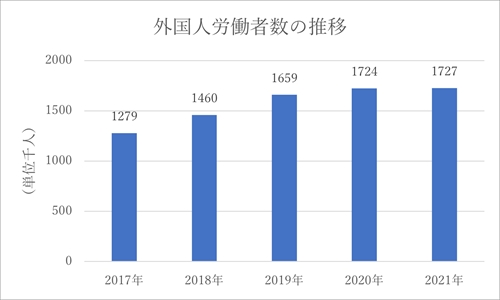
In particular, there is a shortage of IT personnel in Japan, and demand for foreign IT engineers is increasing. For this reason, it can be said that the environment is becoming more conducive to foreign engineers working as front-end engineers. If you want to work as a front-end engineer in the future, consider working in Japan, where there is a shortage of personnel.
What you need to do to work as a front-end engineer in the future

In order to work as a front-end engineer at an IT company in the future, you will need to acquire the following skills, as well as language skills.
- Improve management skills
- Improve UI/UX design skills
- Gain knowledge of web marketing
- Gain knowledge of back-end engineering
Improve management skills
As a front-end engineer in an IT company, you will be working with many team members to progress with development, so you will need to improve your management skills. If you only work as a worker, you will not be able to do a good job as a team. In order to cooperate with each other and progress with development while efficiently dividing up the work within the team, you will need excellent management skills.
If you can improve your management skills by sharing the workload within the team and managing the progress of development, as well as dealing with any problems that arise, you will definitely be able to make the most of your skills as a front-end engineer in the future.
Reference: フロントエンジニアの需要は無くならない?今後の将来性と求められるスキルとは/DMM WEBCAMP
Improving UI / UX design skills

Front-end engineers who create highly visible web pages and web apps also need UI design skills and UX design skills.
The UI of a website refers to the appearance and ease of use of the site. If the UI design is poor, it can cause users to become disengaged, so UI design is an important aspect of a site, as it is the face of the site. UX design refers to the experience that users gain through web pages. It refers to the kind of experience users have and the impression they form of that experience, and if they have a positive impression of the experience, it means that the UX evaluation is high.
UI design and UX design can be acquired by gaining work experience while studying knowledge and skills. In most IT companies, there is a high demand for front-end engineers with strong UI and UX design skills who can create high-value web pages.
Reference: 今さら聞けない! UI(ユーザーインターフェース)とは?/M-HAND BLOG
Gain knowledge of web marketing

Web marketing, also known as SEO, is a strategy for ensuring that your company's website appears at the top of search results when people search for keywords on search engines such as Google and Yahoo! No matter how good your website is, if it doesn't appear in the search results for many people, it won't be accessed.
For this reason, front-end engineers also need to acquire knowledge and skills related to SEO for web marketing activities. In some IT companies, SEO may be included in the job description of front-end engineers, so if you have knowledge of web marketing, you will be recognized as a front-end engineer who can make an immediate contribution.
Reference: フロントエンドエンジニアの仕事内容とは?未経験からの転職は簡単なのか徹底解説/パーソルクロステクノロジー
Gain knowledge of back-end engineering

By acquiring not only front-end engineer knowledge but also back-end engineer knowledge for server-side program development, your demand as a front-end engineer will increase. If you become an engineer who can develop both front-end and back-end, you will be able to see all the development of websites and web apps. IT engineers who can develop both are in high demand from IT companies because they can develop while considering both the front-end and back-end sides.
Reference: フルスタックのWebエンジニアを目指すべき理由/Workship
If you are looking for an IT company where you can work as a front-end engineer, try "G Talent"

If you are looking for a job as an IT engineer, we recommend the job-placement agency 'G Talent' for foreign IT engineers. G Talent has supported the recruitment of over 200 companies and has a track record of helping over 70 nationalities of engineers find new jobs. There are plenty of IT jobs at companies where you can work in a fair environment regardless of your nationality, so you're sure to find a job that suits you.
For foreigners, another attractive feature of G Talent is that you can get support with obtaining a visa and help with writing your resume in Japanese. Because it specializes in IT jobs, you can also find front-end engineer jobs efficiently. First, let's start with a free registration.
Work at a Japanese IT company as a talented front-end engineer!

In this article, we have explained the programming languages and frameworks that front-end engineers should learn, as well as the future prospects for front-end engineers and what they need to do to be successful. In order to become a talented front-end engineer, in addition to the basic languages, you will need knowledge and skills in programming languages and frameworks that are developing now and in the future. In addition to language knowledge and skills, you also need to improve your management skills and UI/UX design skills.
If you are a foreign engineer who wants to work as a front-end engineer, try searching for jobs on the job-placement agency for foreign IT engineers, “G Talent”. There are many global job openings for front-end engineers, so you are sure to find a job that suits you.