In order to be successful as a project manager at an IT company in Japan, you need to be familiar with the way project management is often done in Japan. Knowing how work is often done in Japan will make it easier to participate in projects, so it's a good idea to familiarize yourself with the flow and methods beforehand.
In this article, we will explain the typical project management methods and techniques used in Japanese IT companies, as well as some tips for succeeding in project management in Japan. If you would like to work in project management in Japan, please use IT-related global recruitment agency “G Talent”.
Contents
What is project management?

In IT company project management, the following are the main things that need to be managed.
- Budget
- Schedule and tasks
- Attendance of project members
- Issues
- System quality
In addition to managing the budget, schedule and members of a project, the project manager also manages issues and system quality. The main role of the project manager is to manage the project appropriately in all aspects and lead it to success.
Reference: プロジェクト管理基本のやり方/Shelter
The flow and methods of project management commonly used in Japanese companies

We will introduce the typical flow and methods of project management in Japanese companies. By understanding the overall flow, you will be able to respond smoothly when you become a project manager.
- Preparation
- Planning
- Management
- Closing
Preparation
When managing a project, it is essential to make preliminary preparations to confirm the delivery date, budget, project goals, etc. You should identify the issues and tasks of the project, and assess the difficulty of the issues, how long it will take to solve them, the nature and difficulty of the tasks, and the skill level of the personnel required. It is difficult to assess the difficulty and issues without past experience or skills, so it is also important to seek the appropriate methods and opinions of experts and experienced people as necessary.
Reference: 【新人PM必見】プロジェクト管理の方法とコツ/Lychee Redmine
Planning

Once you have identified and carefully examined the issues and tasks, you can work out a schedule by working backwards from the deadline. When carrying out proper project management, it is necessary to create a schedule that allows you to complete the work without overworking yourself.
At the same time as the schedule, it is also important to assess how many resources and personnel are needed, and what level of skill is required for the allocated personnel. If there are not enough personnel and the schedule cannot be completed within the planned timeframe, it is necessary to coordinate with other departments to get the necessary personnel to help out. If you are also planning to train junior staff, you will need to consider who you will pair up with, and who will be in charge of training them.
Reference: プロジェクト管理に必要な項目と成功のポイントとは?/NotePM
Management

Once the schedule has been decided and the necessary resources have been gathered, the project will be launched and the project manager will manage the entire project. After the project has started, it is necessary to receive progress reports from the members at regular progress meetings, and to have them report promptly if any problems arise in the methods or results, etc.
If manufacturing and testing have started and you receive reports on a daily basis, you may also receive reports on the progress of manufacturing and testing, the number of bugs that have occurred, etc. at the progress meeting. In addition to progress reports, it is also important to communicate closely with project members and be in a position where you can consult with them immediately about even small matters.
In many projects, it is common for some kind of problem to occur. It is necessary to have a system in place where the project manager is always aware of the situation and can deal with any problems as soon as they arise.
Reference: 進捗会議で何を話すのか/サル先生のプロジェクト管理入門
Closing

Once the delivery is complete and all the steps in the schedule have been completed, the project is closed. Closing is the process of reviewing the project content and results and compiling information to be used in future projects. The project manager analyzes the causes of any deviations from the original plan, why these deviations occurred, what went well and what did not, and summarizes the results. For the next project, it is also necessary to summarize the areas that should be reflected on and the areas that should be utilized in the next project.
Reference: プロジェクトや工程終了時に行う7つのポイント – プロジェクト・フェーズ終結/プロマネ研究室
Common Project Management Methods in Japan
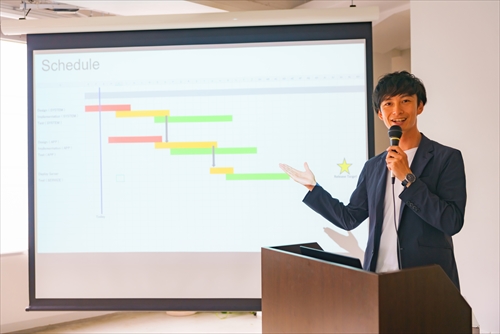
From here, we will introduce some of the specific methods of project management commonly used by Japanese companies. By becoming familiar with the methods introduced here, you can reduce the chances of being confused when managing projects for the first time at a Japanese company.
- Gantt chart
- WBS (work breakdown structure)
- CCPM
- Waterfall development
- PERT diagram
- Agile development
Gantt chart
The Gantt chart is the oldest method of project management. It is managed in a format similar to Excel, with tasks lined up in order from the top row, and the number of days passes as the columns move to the right.
A bar is set for each task, with the left edge being the start date of the task and the right edge being the completion date. The upper and lower bars are divided into the planned and actual, and as progress is made, the actual fills in.
The tasks are arranged in a staircase-like pattern, and it is easy to see at a glance how much the planned and actual progress deviate from each other. However, there are also disadvantages, such as it being difficult to understand the relationship between tasks and it being difficult to respond to major schedule changes.
Reference: ガントチャートって何ですか?/ITmedia
WBS (Work Breakdown Structure)
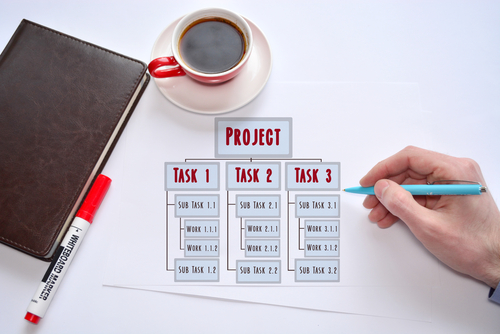
WBS (Work Breakdown Structure) is a method of breaking down tasks into smaller tasks and creating a schedule for them. For example, in the testing process, it is necessary to set the perspective, identify items, prepare for reviews and testing environments, create test data, conduct tests, and check the results. Once the necessary tasks have been identified, the schedule for the tasks is decided and implemented.
By using this method, you can identify what needs to be done to reach the goal and how much work will be involved. However, it also has some disadvantages, such as being subjective and making it difficult to break down tasks.
Reference: WBS(作業分解構造図)とは?ガントチャートとの違いや作り方を基礎から解説/マイナビクリエイター
CCPM
This method, known as Critical Chain Project Management, is often used for large-scale projects, and is a method of minimizing tasks and budgets and allowing for a buffer in the schedule.
It is said that when deadlines for work are set, people often do not start work until the very last minute, so by setting a deadline with a buffer rather than a true deadline, you can eliminate waste and shorten the schedule. However, if an inexperienced manager uses this method, they may end up taking too much of a buffer and creating an unrealistic schedule, so it is a method for experienced managers.
Reference: CCPM(クリティカルチェーン・プロジェクトマネジメント)とは?大型プロジェクトにはCCPMを取り入れよう/株式会社システムイングレータ
Waterfall development
Waterfall development is a method of arranging processes in order, like the flow of water, and has been used for a long time. For example, the project schedule is made up of the following stages: requirements definition, external design, internal design, manufacturing, testing, delivery, and operation.
Waterfall development is often used for large-scale projects where the schedule and work content remain largely unchanged. In the case of large-scale systems where functions are added repeatedly, the project stages remain largely the same. If the work process is established, it is easy to make a schedule and to steadily carry out the project.
However, it is not suitable for projects where the schedule is difficult to change, where a major problem occurs and the plan goes awry, or for short-term projects.
Reference: ウォーターフォール開発とは?メリットとデメリットを解説。ほかの開発手法も紹介!/発注ラウンジ
PERT Diagram
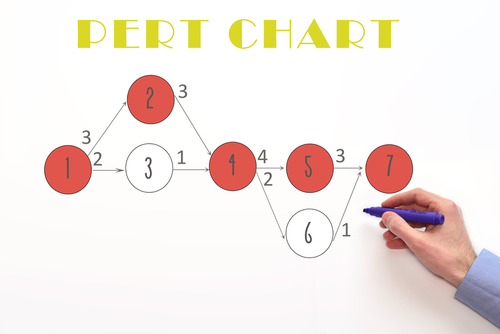
A PERT diagram is a chart that shows the order of tasks and work within a project. PERT diagrams show tasks, work times, work start dates and work end dates, and the order of each task is shown using arrows. It is suitable for complex work orders, such as when work on C can begin after work on A and B is complete, or when work on D and C is not sequential, but work on E cannot begin until C is complete.
Reference: PERT 図とは?仕組みや作成方法を徹底解説/asana
Agile development
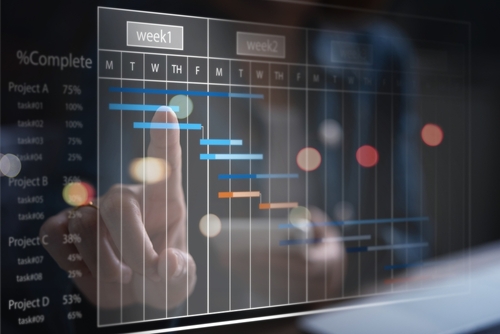
Agile development is a method of project management that repeats processes in short periods of time called “iterations”. It is the opposite of waterfall development, where the entire process is decided from the start, and the process is repeated many times.
For each iteration, plans and goals are set, and the process is repeated in a short span of time, with the issues and results from each iteration being immediately applied to the next. It is possible to carry out flexible and speedy development while repeatedly changing the specifications. However, it will be difficult to carry out a project without problems using this method unless you have experienced and knowledgeable managers.
Reference: アジャイル開発とは? 特徴とメリット・デメリット、スクラムまで徹底解説/Monstarlab Blog
5 Tips for Successful Project Management in Japanese Companies
From here, we will explain some tips for successful project management in Japanese companies.
- Look over the PMBOK
- Utilize management tools
- Setting milestones
- Carry out risk management
- Emphasize communication
Look over the PMBOK
The PMBOK is a kind of reference book that summarizes knowledge about project management. The PMBOK is the world standard for project management, so it can be used not only in Japan but also in any country where project management is carried out.
In some cases, knowledge of the PMBOK is required when hiring a project manager. If you have a good grasp of the PMBOK, it will be useful when carrying out project management work in any country.
Reference: PMBOKとは?プロジェクト達成のための世界標準知識を学ぼう/インターネットアカデミー
Utilize management tools
To carry out project management smoothly, let's actively use management tools. We recommend tools that have all the functions a project manager needs, such as progress management, information sharing with team members, file sharing, and attendance management. If you manage manually using Excel or other software, it is easy to make mistakes or forget things, and it will take a long time. Using a management tool can be expected to improve the efficiency of management work.
Setting milestones

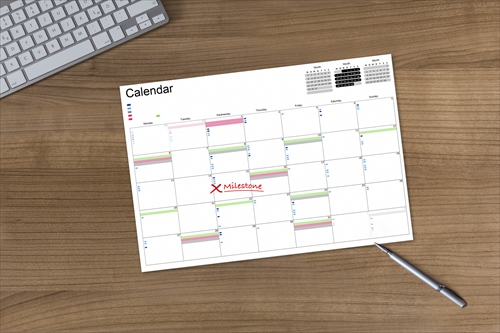
When managing a project, it is important to always be aware of the milestones. Setting detailed milestones, such as checking the direction of the work in progress as well as the deadline for the entire task, can help to prevent delays in progress and also to check the work. Setting specific deadlines for answering questions and submitting materials can also help to prevent them from being neglected.
Reference: マイルストーンとは?意味や使い方を解説!中間目標の設定でプロジェクトを成功させる!/Jootoマガジン
Carry out risk management
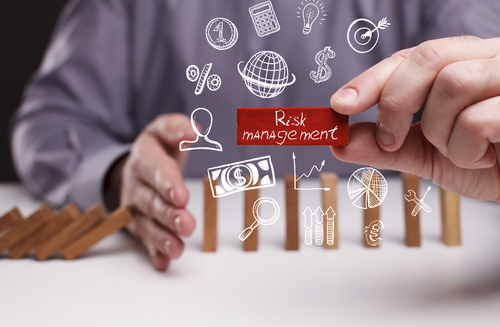
Risk management is extremely important for project managers. For example, if the schedule is tight, you will need to take action such as making arrangements to get people from other departments to help out. Be prepared so that you can deal with anything that happens.
Reference: プロジェクトにおけるリスク管理とは?手法やプロセスについて解説します/Jootoマガジン
Emphasize communication
In order to succeed in project management, it is essential to share information and communicate with team members. It is important to actively communicate with team members, rather than just waiting for them to report.
If the atmosphere is such that team members are unable to raise issues, the problems may not be discovered until they have grown in scale, and the damage may be significant. Make sure you communicate with your team on a regular basis so that you can talk to them quickly when they raise their hand.
Let's find a Japanese IT company that suits you and work in project management!

In this article, we have explained the typical flow of project management in Japanese IT companies, the methods commonly used, and tips for succeeding in project management in Japan. Project management is a very important element for ensuring project success. By knowing the Japanese way of doing things, you will be able to carry out project management smoothly in a Japanese company.
For those looking for IT engineer jobs in Japan, we recommend the foreign IT engineer job change agency “G Talent”. They have experience in supporting the recruitment of over 200 companies and engineers from over 70 nationalities, and they have many jobs registered that will allow you to work as a project manager, so you are sure to find a job that suits you.